
Lipscomb County Clerk Routing for Bench Warrant Files
The County Clerk and District Clerk are functions of one Lipscomb County office, while the JP maintains a separate docket. The combined Clerk's Office handles district criminal, civil, family, and juvenile files and county-court records. A felony warrant connected to a district case should be routed through the District Clerk function; a county-level matter belongs with the County Clerk function.
Its office hours include a lunch closure from noon to 1 p.m. The clerk counter is at 101 South Main, distinct from the courthouse address at 105 Oak Street. Confirm the correct office and timing before visiting.
How Bench Warrants Work in Lipscomb County
A bench warrant is court process connected to a case already before a judge. In Lipscomb County, the court level depends on the underlying matter: the JP and city municipal courts hear many fine-only and traffic cases, the county court handles its own jurisdiction, and felony matters route through the 31st District Court. A judge may issue process after a failure to appear or another unmet court obligation.
The exact trigger and available response depend on the order and governing procedure. A missed traffic date, for example, may involve notice and a chance to reset before additional process. A fine-collection capias pro fine follows a separate post-judgment path. Do not assume all court orders are the same or that paying a balance alone clears every warrant.
Lipscomb County JP Missed-Date and Notice Steps
For justice and municipal court cases, Texas Chapter 45A sets procedures after an initial failure to appear. The court must provide a notice with a new date and time within 30 days, identify the court, and explain options for a person unable to pay in full. The notice also describes consequences of another failure to appear. A person who cannot attend the new setting may ask the court for an alternative date or time.
If a warrant is issued for that initial failure, the judge must recall it when the person voluntarily appears and makes a good-faith effort to resolve the case before the warrant is executed. Call the JP or named city court to learn how it applies the rule to the actual case.
Bench Warrant Issuance in Lipscomb County
The issuing judge acts within the court that has the case. For a JP or city fine-only matter, the court's docket and notice are the records to check. The County & District Clerk's Office has separate county-court and district-court functions; ask for the correct division if the case belongs at that level. The Sheriff serves county process but does not make the court's issuance or recall decision.
Texas does not offer a single public statewide warrant lookup for every county bench order. A case may not appear on a public website at all. Once process issues, ask the clerk for the order date and current status, then follow the issuing judge's directions about a new setting, payment alternative, counsel, bond, or motion.
Capias Pro Fine Procedure for Lipscomb County Fine Cases
A capias pro fine is a post-judgment process associated with unpaid fines or costs, not simply another name for every missed court date. Texas law requires the court to consider undue hardship before issuing it for failure to satisfy a judgment and provides statutory alternatives. The order states the judgment amount and directs the person to be brought before the court or, if it is unavailable, presented to custody under the law.
For a JP or municipal case, ask whether the court will set a hearing to consider hardship or another lawful option. The county's JP page offers an online and phone payment channel, but it does not state that payment alone recalls a capias. Get that confirmation from the judge or clerk.
Texas Chapter 43 describes capias pro fine issuance and recall.
The statutory source sets state rules; the issuing Lipscomb County court explains how to resolve a specific case.
How Bench and Arrest Warrants Differ
A bench warrant responds to a court proceeding or obligation, while an arrest warrant is issued on a complaint or other lawful basis after judicial review. The underlying case and issuing authority matter. Lipscomb County court records are separated by jurisdiction, and a search at one office may not show the other court's process. For the criminal complaint process, see the arrest warrant overview.
| Feature | Bench Warrant | Arrest Warrant |
|---|---|---|
| Trigger | Missed court setting or another unmet court obligation | Complaint or other lawful basis reviewed by a magistrate |
| Who Issues It | Judge handling the existing case | Judge or magistrate with authority |
| Underlying Case | Case already before the court | Criminal accusation or filed charge |
| How It Clears | Follow the court's recall, reset, or appearance process | Follow the court's bond, appearance, or recall process |
A Recall Decision Belongs to the Lipscomb County Issuing Court
The Sheriff can confirm a county service contact, but the Sheriff cannot change a judge's order. The court that issued the warrant decides whether to recall it, accept a payment, reset the case, or require an appearance. If a city citation names Booker or Follett, call that municipal court. If it names a JP case, contact the county Justice of the Peace. A district or county court matter should go to the matching clerk function.
Keep the cause number, citation, and any prior notice nearby. Ask whether a new date is available and what documents or fees apply. The county sources reviewed do not publish a universal walk-in recall docket, bond window, amnesty event, or one payment amount for all cases.
Clearing a Bench Warrant in Lipscomb County
First confirm that a warrant exists and ask which court issued it. An attorney can review the case and discuss a motion to recall or quash, a voluntary appearance, or bond if the court permits it. The court may also explain a reset, payment option, or hardship hearing. A Sheriff call alone does not resolve the underlying obligation.
- Use the citation or docket to identify the court and confirm current status.
- Ask the court what it requires before a voluntary appearance or payment.
- Consult an attorney about a motion, bond, recall, or safe appearance plan.
- Follow the court's written instructions and confirm that the order and any DPS report were updated.
Caution: Do not assume a missed setting has disappeared; confirm the case with the issuing court and get legal advice before appearing.
Chapter 45A Gives Lipscomb County FTA Questions to Ask
For an initial failure to appear in a justice or municipal court, Texas Chapter 45A requires notice with a later date and information about alternatives when full payment is not possible. If the person cannot attend the new setting, the statute allows a request for another date or time. When an initial FTA warrant has not yet been executed, a voluntary good-faith appearance to resolve the matter requires the judge to recall it.
Those state rules do not identify whether a particular court sent notice or issued process. Ask the JP or named city court when the notice was sent, whether an alternate setting can be requested, and what it will accept as a good-faith effort. The county does not publish a remote-hearing request form.
Lipscomb County Courts That Issue Bench Warrants
Use the court printed on the citation, notice, or cause papers. The countywide JP handles its own traffic and Class C docket. Booker and Follett appear in the current Texas municipal-court directory, while the directory reviewed did not list Higgins or Darrouzett. The 31st District Court handles district-level cases, and county-court records route through the County Clerk function of the combined Clerk's Office.
If you cannot identify the court, call the JP at 806-862-3844 for county precinct matters or the Sheriff at 806-862-2611 for a county law-enforcement routing question. Do not ask one clerk to recall another court's warrant. The county warrant overview maps the offices and their separate record roles.
The county JP publishes contact and payment details on its own page. Review the JP information before relying on an online payment channel.
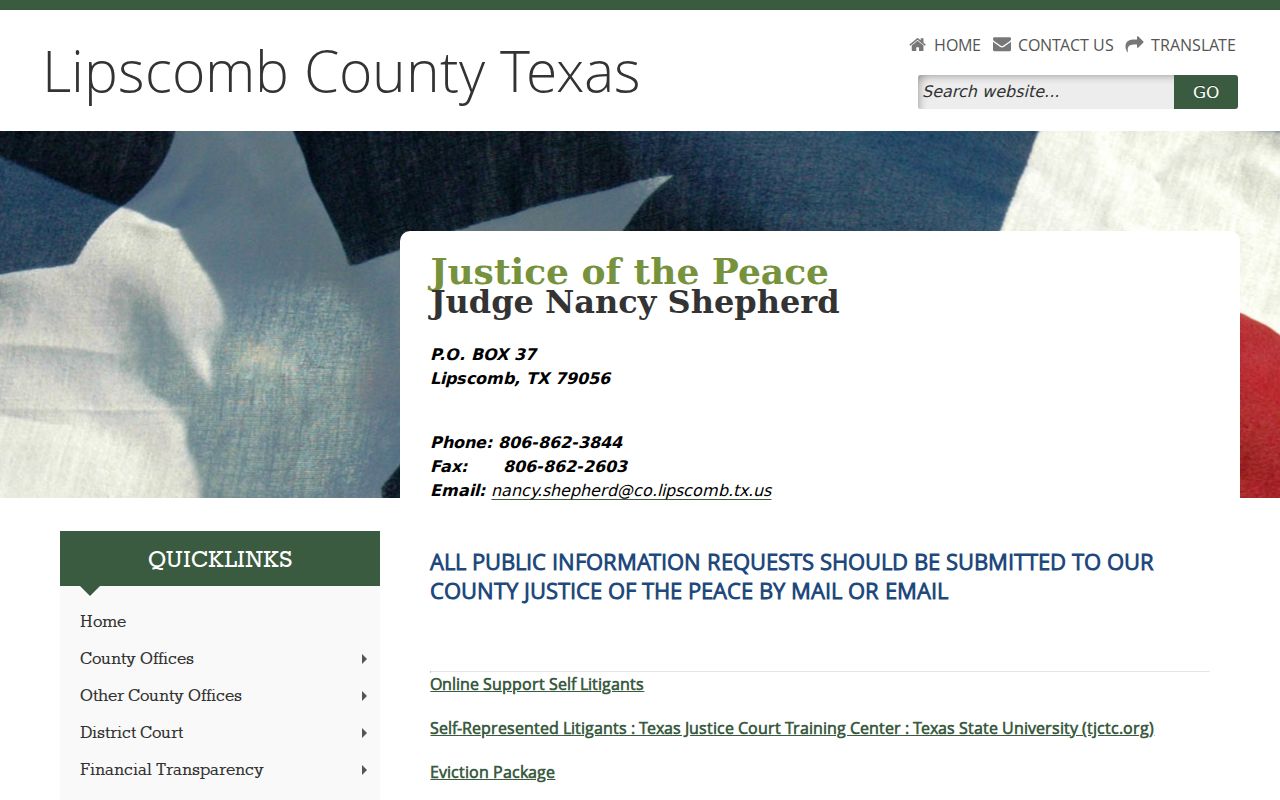
The page identifies the countywide JP and traffic payment route; it does not promise automatic warrant recall after payment.